Bele Chere 2011

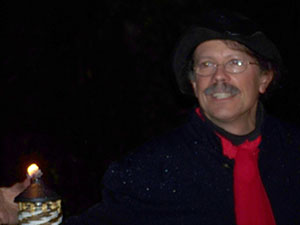
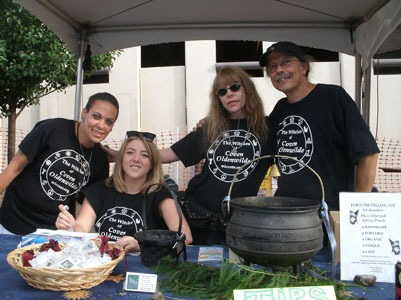
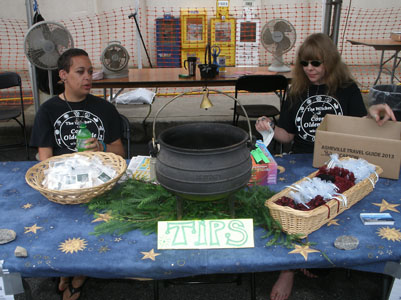
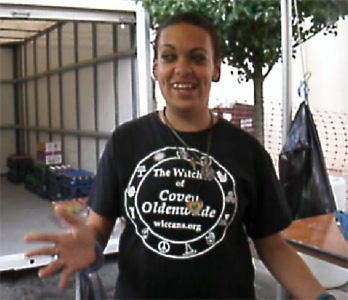
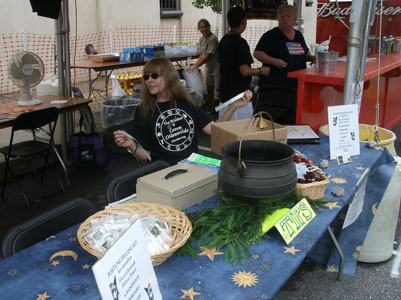
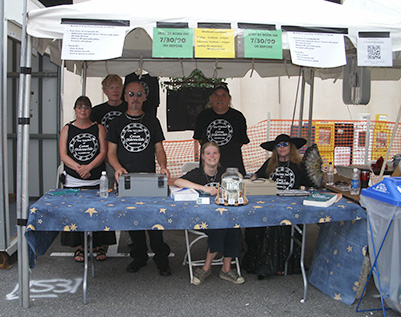
Volunteers in booth, wearing "Witches of Coven Oldenwilde" t-shirts

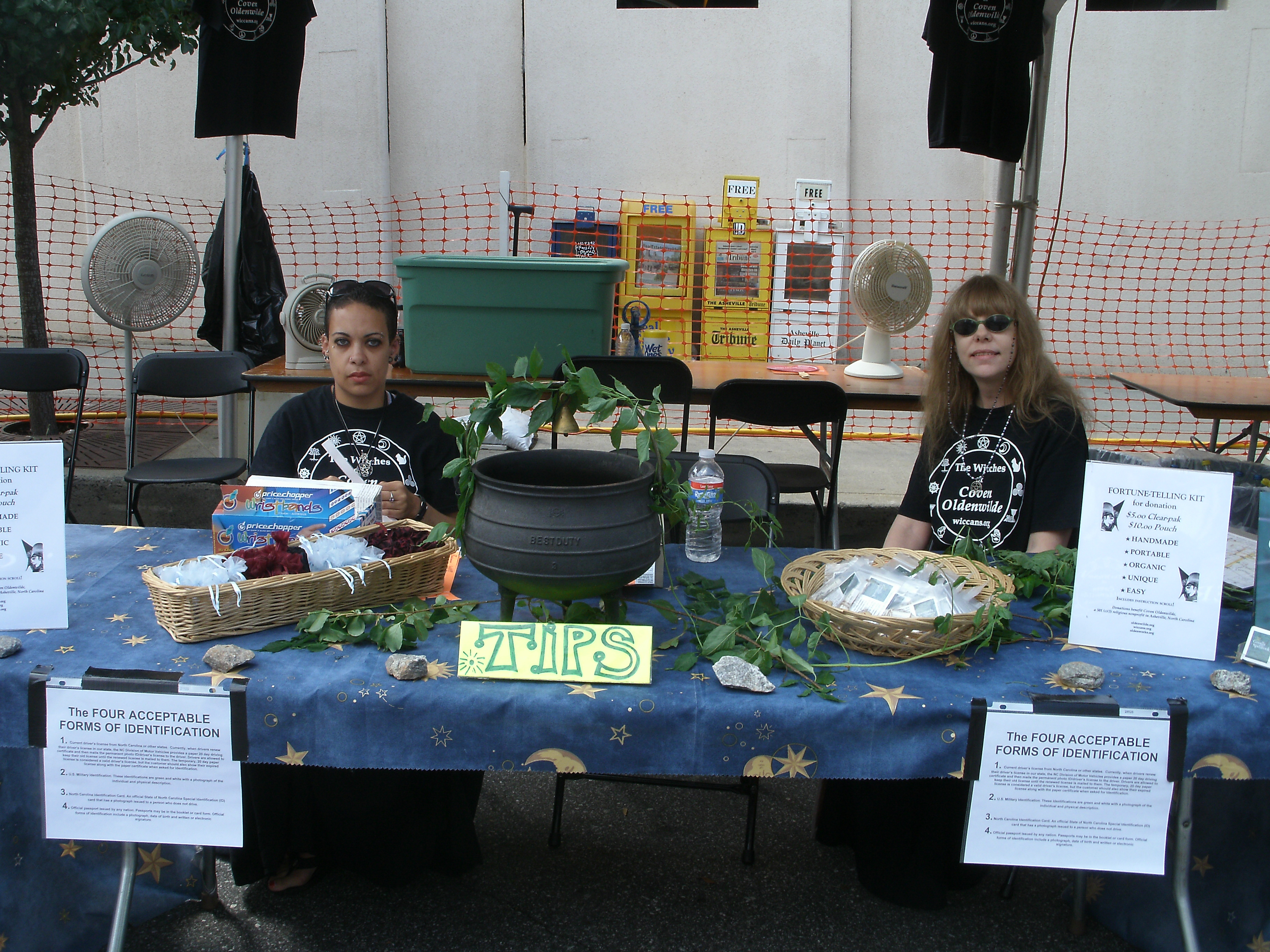
Volunteers at Coven Oldenwilde's wristband booth. (All photos by *Diuvei.)

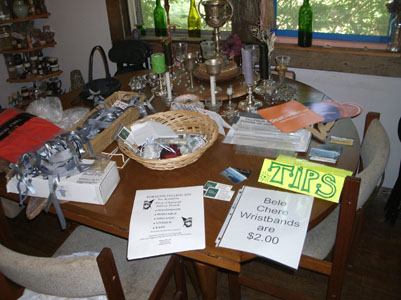
Good company! Bele Chere is the Southeast’s biggest annual street festival, and for the first time ever the city of Asheville invited us Witches to help out. On Friday and Saturday, July 29 and 30, 2011, volunteers from Coven Oldenwilde clad in bold Witchy t-shirts staffed a booth by the Battery Park Stage, selling $2 permission-to-party wristbands (which some term Bele Chere’s cheapest souvenir). It was hot, hard work, but a lot of fun and a great chance to meet and do a little magic for some 2000 folks who stopped by from all over the world.

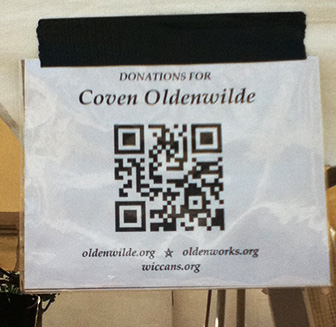
Donations for Coven Oldenwilde, oldenwilde.org, oldenworks.org, wiccans.org

This QR code on a sign we hung on our booth opens www.oldenwilde.org on a smart phone.

Count on Witches to look at QR codes and see magic sigils! (“Quick Response” codes are those square bar codes you scan with a smart phone to link to a website or capture contact information.) We used them at Bele Chere to draw tips and tell fortunes.

Glass jar on lazy susan with QR codes, Egyptian goddess

"Spin the tip jar and scan your fortune": The QR code closest to the person spinning the jar contained a divination for them.

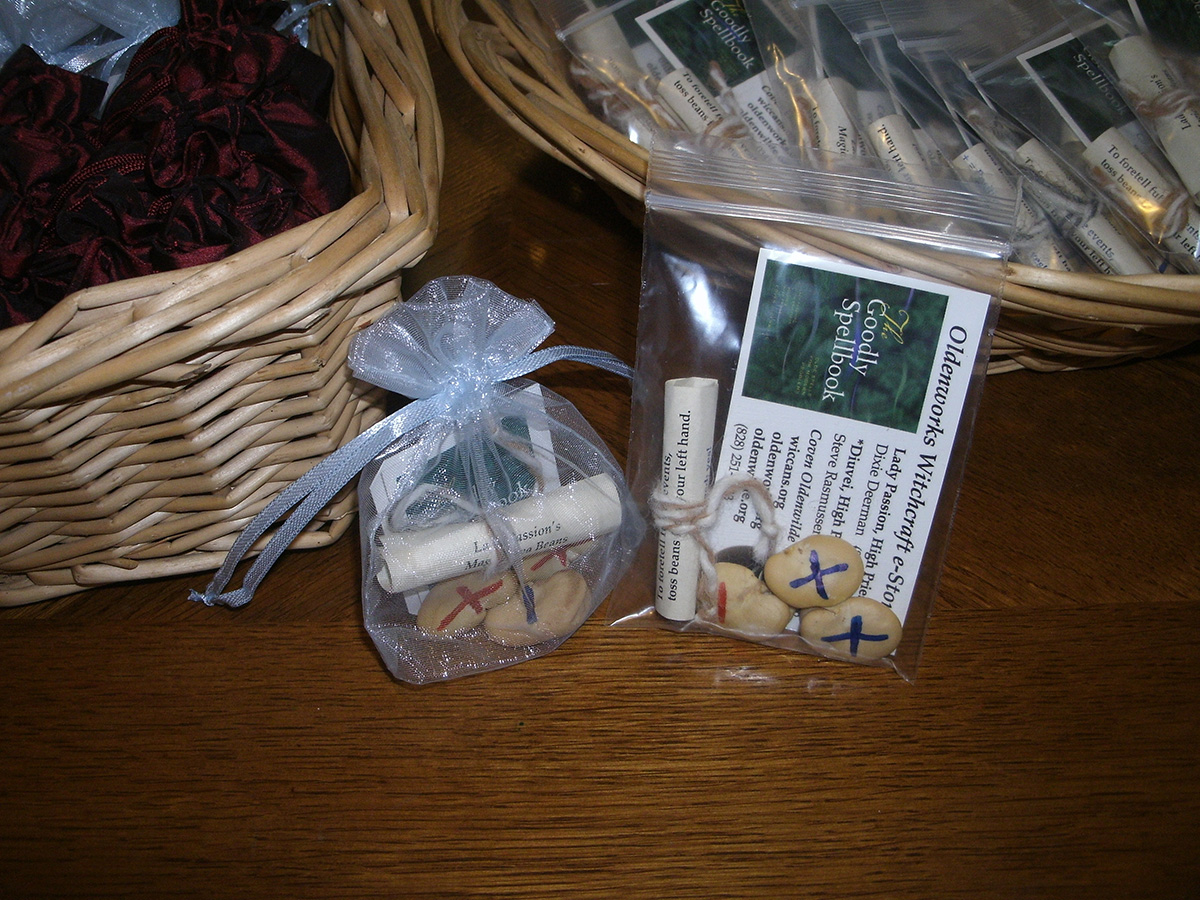
*Diuvei translated nine divinations written by Lady Passion into QR codes. We attached a big bean jar to a lazy susan, and affixed the nine codes (each identified with a color) around the edge. At our booth, we invited wristband-buyers to drop a donation in, spin the jar, then look at the QR code that ended up closest to them. If they scanned it on a smart phone, the QR code would give them a fortune — such as “Love yourself and the world will follow” or “Stop worrying and start dancing” — along with Coven Oldenwilde’s website and contact information. If they didn’t have a smart phone, we would have them tell us the QR code’s color and we would read them their fortune from a translation key.

By the time we rolled up the Coven banner and headed home Saturday night, we’d performed hundreds of divinations — uncannily accurate, by all accounts. The QR-code fortunes even ran in patterns — for example, “Eat, drink and be merry” turned up constantly on Friday, but Saturday’s theme was “Love the one you’re with”.

Lady Passion holding up two fingers.

Victory (and peace) at the conclusion of two exhausting but exciting days.

Although we heard many complaints about the bullhorn-wielding street preachers who rant at attendees every year, we had no trouble from them or any other intolerant ilk. Indeed, we received nothing but interested questions and enthusiastic compliments about the Witches’ presence at Bele Chere 2011.

Posted in Community Service | Comments Off

Coven Oldenwilde’s Response to Internet Libel on Realpagan.net

It is a kingly thing, O Cyrus, to do well and to be evil spoken of.
— Antisthenes, founder of the Cynic school of philosophy

It isn’t easy being Gardnerian. As if we don’t catch enough flak from misinformed skeptics outside of our Tradition who claim Gerald Gardner made up Wicca, many of us Gards also weather attacks from the inside by misguided fundamentalists who insist their particular “praxis” (set of practices) is the one true and only “legitimate” Gardnerian way.

Recently Coven Oldenwilde, Lady Passion and *Diuvei, and our California Line Gardnerian lineage have been the target of lies and libels by a small clique posting on (and apparently running) a site called RealPaganNetwork: RealPagan — Paganism for the Real World. We don’t know these folks, but their motivation seems to be the usual one — to build up their own status by tearing other people down.

Online smear campaigns are all too common nowadays, and anybody’s reputation can be targeted and tarnished by enemies you didn’t even know you had. We’ve pursued the following course of response, which a consensus of experts recommends if you are a victim of Internet libel:

  1. Reply promptly and directly. A fair, ethically operated online forum should allow someone who’s being accused to reply to their accusers, as a matter of basic justice. In hopes of being able to post a factual response, *Diuvei applied to realpagan.net for forum membership.
    Result: Realpagan.net administrators not only yanked *Diuvei’s membership almost immediately after it was approved, but installed a censorship cookie on his computer that prevents him from even viewing realpagan.net. (When he tries to access the site, a screen appears saying he has been “suspended from RealPagan- Paganism for the Real World”.)
  2. Contact the site administrator. Ethical web forums give a way for the public to contact a webmaster or administrator. Realpagan.net does not, but by “following the money” *Diuvei tracked down the e-address through which the site’s creator, one “Sangraal”, solicits PayPal donations. He notified Sangraal that the libelous and defamatory content of the thread overtly violated realpagan.net’s published Terms of Service, and that he was being prevented from posting a reply.

    Result: No response to *Diuvei’s email.

  3. Contact the site’s host or server. Responsible Internet companies that host public websites and forums honor their own Terms of Service by investigating and acting on clear TOS violations. Ning.com, which hosts realpagan.net, claims to abide by an especially comprehensive and restrictive TOS, so *Diuvei sent a complaint about the libelous and defamatory thread to Ning.com.

    Result: Ning told *Diuvei they would do nothing unless compelled to as the result of a lawsuit. They did, however, consent to his request to forward his complaint to realpagan.net’s administrators. No response from realpagan.net (unless you count ratcheted-up name-calling and attacks against us and our lineage on the forum thread).

  4. If going through channels gets you nowhere, push back. Post a response on your own website or social media, and encourage your fans and friends to do the same on the offending site and elsewhere.

    Result:

Our response

to the false, defamatory lies that RealPaganNetwork: RealPagan — Paganism for the Real World has published about the CalGard Line, Coven Oldenwilde, *Diuvei, and Lady Passion at:
http://realpagan.net/m/discussion?id=6330711%3ATopic%3A158262
.

  1. “Stories of abuse”: It’s bad enough that this malicious post is erroneous … it’s also embarrassingly ungrammatical!: “There are stories of abuse towards students and seekers that have be laid at the foot of Oldenwilde and Lady Passion.”
    Fact: The only such “stories” about us were fabricated 15 years ago by a small group of students after we ejected them from our Coven for having lied to and thieved from us.

    Indeed, thousands worldwide call Lady Passion one of the wisest, most compassionate, and genuinely Witchy people they’ve ever had the honor of communicating with (many writing so in their Amazon.com reviews of The Goodly Spellbook and at http://oldenwilde.org/consult-lady-passion/.)

  2. “Skeevy”: Asdea/Jasper’s characterization of Lady Passion as “skeevy, weird, rude” reeks of misogyny.

    Fact: *Diuvei’s review of Asdea’s e-mails to Lady Passion and her responses to him found that Lady Passion simply denied, politely, the veracity of Asdea’s unsolicited “energy sensing” of her, and patiently explained to him the reasons why tradition associates the Four Elemental Humors with bodily fluids, which he had disparaged as “unseemly.”

  3. “NOT a Gardnerian coven”: RealPagans’ assertions are wrong that Coven Oldenwilde is “NOT a Gardnerian coven…” and “Lady Passion is not a Gardnerian. Her working partner, a CalGard with questionable training and lineage, raised her to [Third Degree] in a circle he cast without a HPS present or casting the circle.”

    Fact: The names of Lady Passion’s and *Diuvei’s initiators and elevators to the Gardnerian 3rd Degree, and the dates when these ceremonies took place, are publicly posted at:
    http://oldenwilde.org/oldenwilde/members/PandD.html.

    The California Line of Gardnerianism (“CalGard”) is unquestionably legitimate, and *Diuvei’s Gardnerian training in Coven Tobar Bhride and elevation to the Sublime and Ultimate Degree by Lady Maeve and Niklas Gander of Coven Triskell are above reproach.

    The California Line originated in the 1980s with Gardnerians on the West Coast who declared their independence from the dictates of the New York-based Long Island Line. CalGard’s founders, who included *Diuvei’s Elders, had become fed up with the then-current Long Island Line Elders’ homophobic refusal to acknowledge same-sex initiations and covens; with their rigidly literalist, Bible-like adherence what proved to be a flawed, incomplete Book of Shadows; and especially with their arrogant, very un-Witchy self-appointed role as arbiters of Gardnerian orthodoxy. Amazingly, nearly 30 years later nothing has changed, to judge by the condemnations of CalGard’s supposed heresy on realpagan.net.

    California Line Gardnerians use the same initiation and elevation rituals as other Gardnerians, but allow males to cast circle without a Priestess, either for same-sex initiations or in case of necessity. To the best of our knowledge, no Gardnerian HPs lived anywhere near our area many years ago when, with his Elders’ approval, *Diuvei legitimately cast the circle and elevated Lady Passion to the 3rd Degree. “Honi soit qui mal y pense!”

    Incidentally, our upline Gardnerian Elder Raymond Buckland, the respected Craft author and original founder of the Long Island Line, expressed no concerns about our CalGard lineage when he gave our The Goodly Spellbook a glowing review. (Already by the 1980s, it should be noted, he had distanced himself from the Long Island Line.) And speaking of books, CalGard scholars, particularly our Elder Morgann, have spent many years carefully researching the Gardnerian Book of Shadows, tracking down and re-incorporating lost, variant, and excised materials from every known Gardner-descended line to create a much more complete and useful edition than any individual Gard line possessed up to that point. It is thanks to these California Gardnerians’ assiduous scholarship that Gardnerian initiates can now see plainly for themselves that Gerald Gardner was telling the truth when he said he was publicizing and passing forward a very old — and very diverse — continuous British “Witch cult”.

Bottom line: Ilk who take it on themselves to smear successful religious activists and Craft authors such as ourselves invariably lead one to suspect not only the paucity of their own magical accomplishments, but also their jealous motivation. And by denigrating an entire initiatory lineage of fellow Witches simply because it refuses to insist on perpetuating an unjust, outdated sexual prejudice, they prove themselves to be “real Pagans” in name only.

In doing so they act no differently than intolerant fundie Xtians who wrongly insist that magic isn’t real, that Wicca’s adherents are all devil-deluded. They do the Craft of the Wise a grave disservice, and unfairly give all Gardnerians a bad name in the wider Wiccan community.

As the Ardanes exhort: “Be not as these.” We encourage Seekers and Witches to “keep ever to your highest ideals” and desist from spreading clish-ma-claver (the Witch Word for rumors and lies).

Posted in Discernment | Comments Off

Love is the Law: The Pagan Side of Marriage

Goddess and God uniteEros is a cunning desperado who defies every moral authority’s attempt to straighten him out. Church-led campaigns to deny legal recognition to same-sex and cohabiting couples only enhance his daring — and expose the hypocrisy of religions that claim to look out for our souls but, when confronted with Love’s innately Pagan spirit, can’t see past our genitals.

Whenever a political measure to extend or deny civil rights and benefits to “nontraditional” relationships gains public attention — such as last May’s ballot measure in my state, North Carolina, that imposed the one-man-one-woman definition of marriage on our Constitution — fundamentalists move in and loudly monopolize all religious discussion of relationships. Their “family values” arguments always come down to “original sin” — the doctrine, dating back to the writing of Genesis, that flesh is inherently wicked, and making love for any reason other than making babies is wrong. Hence popes proclaim homosexuality to be an “intrinsic moral evil” (Pope John Paul II in 1986), and preachers condemn cohabiting outside the purifying “sacrament” of matrimony as “living in sin”.

After two decades of co-leading a highly public Witch coven in Asheville, in one of the most religiously conservative areas of the country (a stone’s throw from Billy Graham’s headquarters), I’ve become all too familiar with fundamentalists’ judgments of who’s good and who’s evil — and why. Fundamentalism accurately defines itself as scriptural literalism — the insistence that the Bible, Quran, Torah, or whatever text is revered as the One True God’s sole word on a given subject must be interpreted, not as symbol or metaphor, but as objective and inviolate truth. Fundamentalists claim to judge you by the letter of their law, not by its spirit.

But you’ll get nowhere with them by arguing how subjectively and selectively they pick those letters. It’s pointless to counter-quote those sensuous paeans to erotic love in the Psalms, for example. Literalism is just a symptom of fundamentalism’s obsession with the outer forms of things — their appearance, categories, and labels — and with forcing the seemingly confused and conflicting babel of diversity into the seductively simple, static, black-and-white, God-above-vs.-Devil-below, no-weeds-allowed-in-my-perfect-lawn order that people drawn to fundamentalism crave.
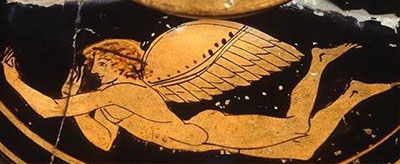
Love’s rebellious disregard for such tidy moral schemes compels religious fundamentalism to reveal the mechanistic mindset that it paradoxically shares with its mortal enemy, scientific materialism. The orthodox religious rationale that love without resulting procreation violates God’s cosmic order is uncannily similar to the Godless genetic reductionism espoused by biologists of the “selfish gene” school of thought who assert that our anguished longings and heartfelt yearnings for one another are nothing but our genes machinating via hormones and pheromones to perpetuate themselves.

So in the end, Extreme Religion and Extreme Science — two ideological poles of modern civilization that are supposed to be diametrically opposed, whose advocates continually battle over fetal souls vs. embryonic stem cells, creationism vs. evolution, divine design vs. random chance — seem agreed on one thing: the dismissal of love. If all that torrid full-moon-serenade, caution-to-the-winds, stuff-of-poetry-and-drama romance doesn’t result in offspring, it’s either spiritually sinful or biologically frivolous. Get back to your cubicles, you lovebirds, and spend your lunch breaks reading your Bible or A Brief History of Time.

Thank Aphrodite, I and my fellow Wiccan priest/ess (and longtime cohabiting partner) are Pagans. She and I, along with the enormous diversity of folks we serve as clergy, can draw from a far older, much deeper and more inclusive well of wisdom about love and relationships than one can find in either of these upstart modern sects.

One of my favorite go-to sages is Plato, the pre-Christian “father of philosophy”, and in particular his teacher, Socrates, whose profoundly Pagan awareness of the unity of reason and mystery radiates from Plato’s writings. Like nearly all practitioners of the world’s countless forms of indigenous spirituality that we nowadays class together as Paganism, Socrates was a polytheist who believed that the divine reflects itself through not just one, but many gods and goddesses; and an animist who recognized that nature is not inert matter, but imbued with soul. His wisdom, however, is not issued as authoritarian judgment: Unlike the lists of commandments laid down like the proclamations of a monarch in monotheistic scriptures such as the Bible and Quran, Plato’s dialogues weave themselves democratically around not only Socrates’s perpetually dissenting questions, but also the diversely opinionated give-and-take of many other individual voices.

The “Symposium”, one of Plato’s most famous works, confronts the controversies of love. Is it merely lust for an attractive body, as materialists then and now maintain? Is it about singular commitment to a soulmate — like the intimate camaraderie between Achilles and his fellow warrior Patroclus? Is homosexuality in fact a nobler form of love than heterosexuality, for the very reason that it does not result in physical progeny? Is love a god, is it madness, or is it both? All these theories are debated freely around the Symposium’s banquet table.

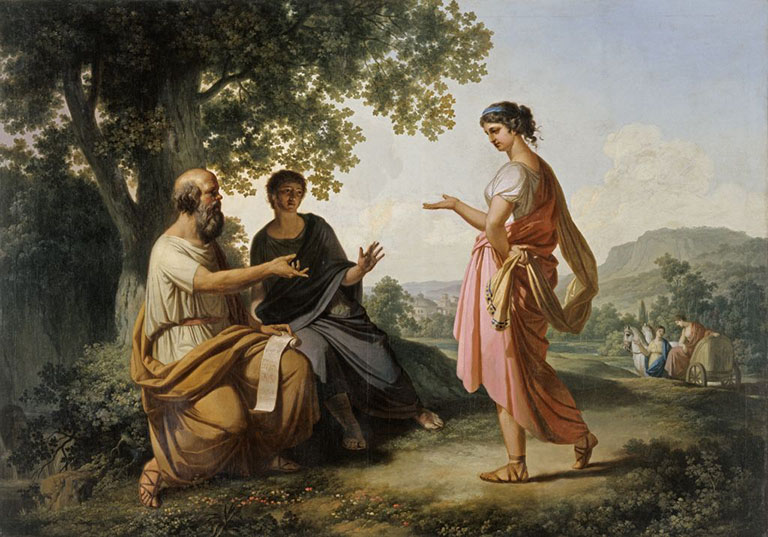
But Socrates gives the game-changing answer to all questions about the nature of love when he recounts a youthful discourse with his first instructor in the ways of love: Diotima of Mantinea, a prophetess — or as we’d now call her, a witch — whom he also credits with teaching him the questioning technique that we now call the “Socratic method”. (Whether she schooled him as well in more intimate techniques goes discreetly unmentioned.)

Love, the witch taught the philosopher, is not a god or goddess, but a spirit who communicates between ourselves and the gods. He is demanding yet crafty, the son of Need and Resource, a determined seeker who gives up everything and stops at nothing in his quest for beauty. Diotima explained that although courtship between man and woman that leads to children and family is admirable, it’s just one of Love’s noble pursuits. Another is procreation of things of the spirit, such as art or law — creating, through the inspiration of one’s relationship with a friend or lover, “something lovelier and less mortal than human seed”.

A would-be initiate into Love’s true mysteries will begin by falling in love with the beauty of one individual body, then with every lovely body — but will not remain content with mere physical lust. He or she becomes smitten with the beauties of the soul, even when it inhabits an unlovely body; then with the interrelated beauties the lover contemplates in laws, institutions, arts and sciences — in every kind of knowledge; and ultimately with the timeless, universal, divine beauty in which all lovely things partake.

In other words, love is the lens through which the beauty of life reveals itself. It’s not a being or thing that exists apart, aloof unto itself like a god who bestows favor from a distant heaven: It exists as relationship, like a spirit that flies between realms. This lens can be clear or cloudy, your relationship healthy or unhealthy to the degree that it connects you with or distracts you from the inner beauty of your beloved — but it’s this intangible essence that matters, not the corporeal form on which your love is focused.

Straight, gay, bisexual, polyamorous … researching cancer, collecting stamps, smoking pot — Pagans don’t categorize whoever or whatever you love by its outer labels and appearances as inherently good or evil. We don’t scour the Almighty’s book of taboos to see if the prophets have banned it along with mixing linen and wool or eating beasts without cloven hooves. In contrast to fundamentalist monotheism, Pagan polytheism encourages pluralism: Accepting and learning to worship multiple gods and goddesses, rather than just one, trains us to seek the inner common threads that run through the world’s outer babel of names, symbols, rituals, cultures, languages, etc. — in short, to judge books by their contents, not their covers.

This doesn’t mean that anything goes as long as it gets you off. For example, things got pretty tricky for the Greeks when they started debating man/boy liaisons. At the time, the upper classes considered it socially acceptable for a wealthy older man to court a handsome young boy as a lover. (If today’s disgraced priests and coaches had been employed in ancient Athens, they would probably still be collecting their drachmas and cornering their adolescent charges in the communal baths.) But the discussions in Plato’s dialogues reveal how controversial the practice really was, especially among parents, because it typically led to sexual and emotional abuse of a trusting child. From various angles Socrates presses his aristocratic listeners to direct their quest for beauty to a boy’s mind and soul rather than his body — to practice what we now call “platonic” love.

As Diotima and Socrates pointed out, it’s not about whom or what you love, but how. Love turns ugly and meaningless when a lover exploits the object of love for selfish ends. Harm none, and treat others as you would be treated — as ends in themselves, not means to your own — is a Pagan ethic of compassion that can’t be commanded, but comes naturally when you begin to care more about people’s hearts than their breast sizes. It’s the same advice lovelorn singles receive: If you want him/her to return your messages, you must value them as a person, listen to them, ask them about their day, and mean it.

In contrast with materialists and monotheists, this wise ethic of Love also informs Pagans’ animistic relations with Nature. If carpentry is our passion, we don’t treat a tree as mere board-feet of lumber to be milled in whatever way the almighty market dictates to maximize profit. Nor do we look down on it as a baser creature than ourselves, to be chainsawed without a qualm because “the Lord” granted Man dominion over all creation.

Instead, woodworkers whose values are Pagan strive to honor the life and soul of the tree. Before chopping down its body, they follow the widespread ancient tradition of making a prayer or offering to its indwelling spirit. When cutting or carving it, they respect its unique qualities of color, grain, strength, etc., courting and coaxing the wood to reveal its inner beauty. When its designated use is done, they strive to recycle it for new uses rather than callously discarding it in a dump. From the beginning to the end of his or her relationship with the tree, a pious Pagan treats it with love.

Still, Eros is a restless rogue. If untempered by conscience or compassion, he can trample family, friends, and colleagues like a rampaging bull to reach the latest object of his obsession. Marriage is not just a personal ceremony of commitment — it’s also society’s effort to protect itself from desire run amok, constraining it by the timeless magic of oaths, talismans, and spells. Brides and grooms swear a vow of commitment before a representative of universal law and justice — whether a religious priest or priestess, or a secular judge, ship’s captain, etc. The oath is sealed with a symbol of binding — whether a gold ring, a knotted ribbon, etc. And they participate in ritual acts to bless their crossing of this new threshold in life — whether jumping a broom to grant them partnership, cutting a cake to forfend hunger, smashing a glass to remove hardship, etc.

The central purpose of all this matrimonial magic is to secure the heart-to-heart vow that is still sometimes referred to as a “pledge of troth” — a promise of mutual trust. Such compacts are, after all, the invisible ligaments that bind society together like the gravitational forces that bind the planets to their orbits — from the “full faith and credit” that backs a federally secured mortgage, to the “oath of office” administered to those we entrust with making and enforcing laws, to the “truth, the whole truth, and nothing but the truth” we vow to testify to in a court of law.

The way Pagans see it, as long as pledges made are honorably upheld, society’s need for stability is fulfilled. It doesn’t matter what genders the wedded troth-keepers are, nor whether they are a couple or a triple or a harem: What counts is their fidelity to one another, and their refusal of temptation to break the bond by lying to or cheating on one another. By contrast, it generates social chaos and instability when fundamentalist-influenced voters and lawmakers impose needless stress on a relationship by denying the partners in a mutually committed gay, common-law, or polyamorous marriage the right to participate in civil benefits granted to other couples solely by virtue of their being one man and one woman, granted one seal of approval.

It also frays the social fabric to insist on tying the bond so tight that it threatens to suffocate the participants. Vowing to unite “till death do us part” is a remnant of days now distant for all but the wealthiest among us, when a formal marriage cemented political and economic alliances between two families, clans, or kingdoms — when wars and fortunes might ride on the question of which bride had the most to offer, which child of the union was the “legitimate” heir to the bloodline.

Put bluntly, these days it’s spiritually unconscionable to insist, as I’ve seen religious conservatives do, that divorcing in order to leave an abusive, irreparably troth-broken marriage is more immoral than preserving matrimonial bonds — to elevate, once again, the outer form of the relationship beyond its inner purpose. And in today’s atomized “hookup” culture, it’s irresponsible for clergy to categorically condemn all sexual exploration unless it leads to lifelong commitment and childbearing.

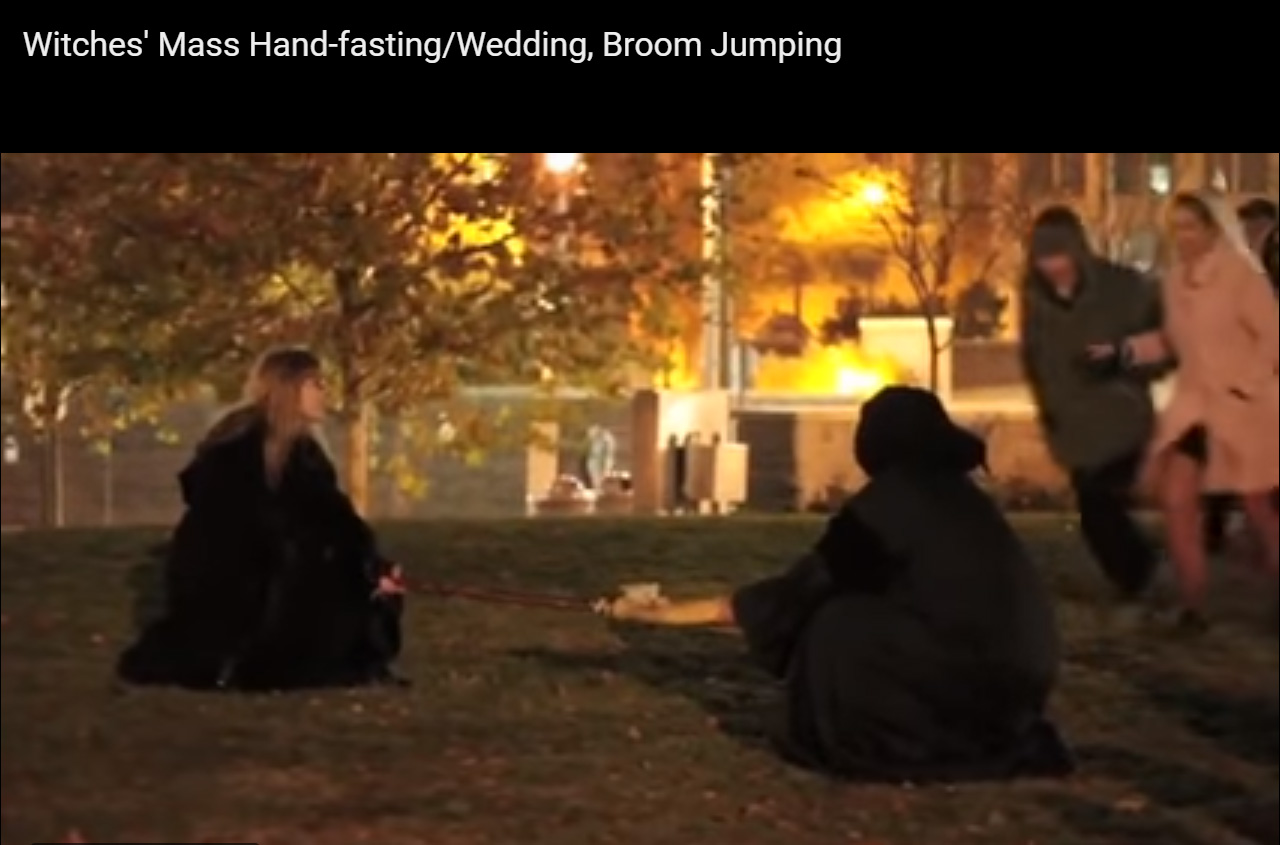
As Wiccans, Lady Passion and I are empowered by our religious tradition to bond lovers in an ancient, much more flexible form of trial marriage called “handfasting”. For a year and a day, each vows to “cleave to you and to you only, as long as love be in our hearts”. At the end of this time, they can renew their vows, make them permanent, or sever the relationship and formally “handpart” as friends. (My partner and I have been renewing our vows for nearly 20 years and 20 days so far.)

As clergy, we are also empowered by our state’s law to sign and seal the document that makes a marriage official — but only for one man and one woman, for life. That restriction is, in our view, an outdated and unconstitutional imposition by the government of fundamentalist Christianity’s misconception of what constitutes love and marriage.

That’s why, this Halloween, Coven Oldenwilde will be devoting Asheville’s 18th Annual Public Samhain Witch Ritual to protesting this law — and casting a spell designed to change it — by conducting a mass wedding, handfasting, and vow renewal for lovers of any gender or number in front of our county courthouse (where our county commissioners recently refused to extend anti-bias protections to homosexual county employees).

The rite’s theme, “Love is the Law,” alludes to the magician Aleister Crowley’s famous seven-word declaration, which captures Pagans’ inclusive yet intimate understanding of that spirit child of Need and Resource who cannot be tamed, yet flourishes when channeled:

“Love is the law, love under will.”

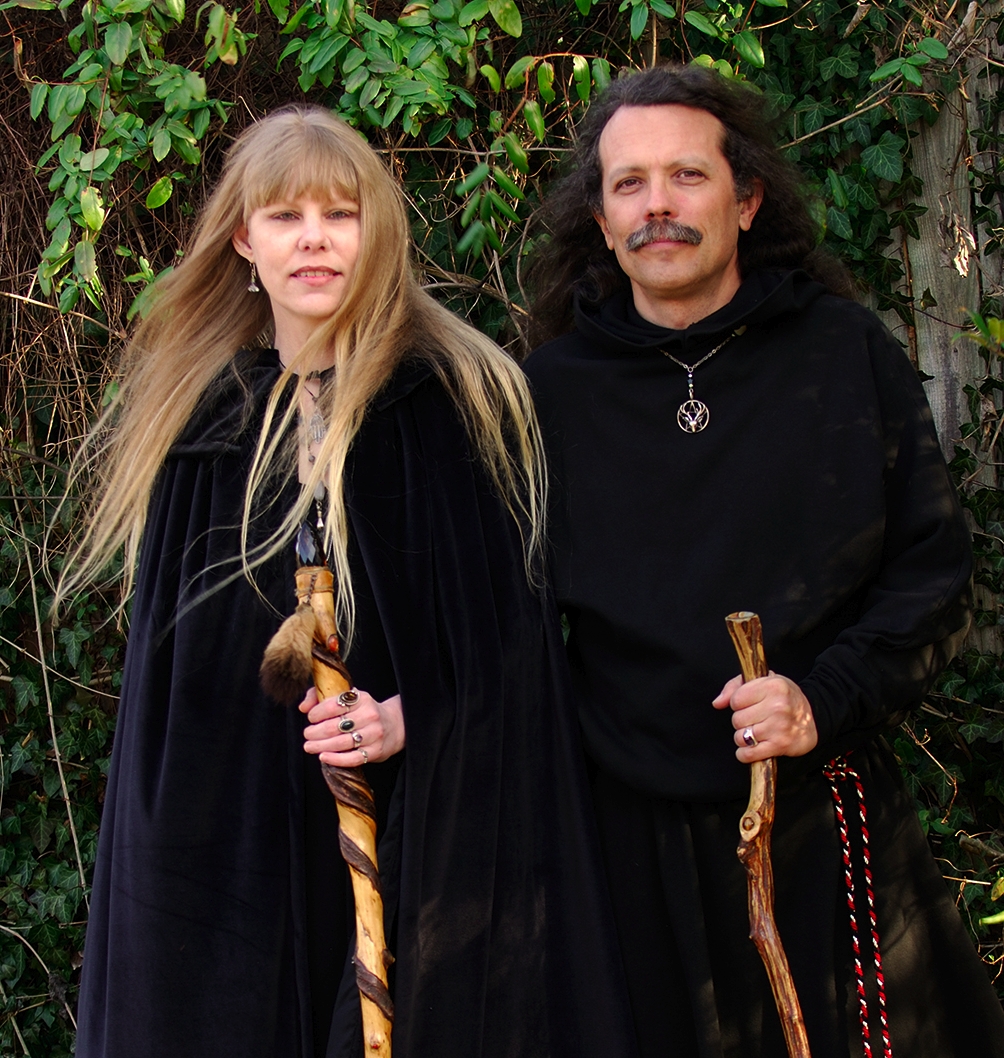
Steve Rasmussen (*Diuvei) is the High Priest of Coven Oldenwilde in Asheville, NC, and co-author of “The Goodly Spellbook: Olde Spells for Modern Problems” with his partner and High Priestess, Dixie Deerman (Lady Passion). To contact him or learn more about Wicca and the Samhain Public Witch Ritual, visit: www.oldenwilde.org.


Posted in Pagan Perspective | Tagged , , , , , , , , | Comments Off

Bele Chere 2012: The Rule of Two

Slideshow of Coven Oldenwilde’s wristband booth and volunteers at Bele Chere 2012.

First time’s beginners’ luck; second time’s a challenge. That’s the “Rule of Two” we wrote about in The Goodly Spellbook, and our second year running a nonprofit wristband booth at Bele Chere, the Southeast’s largest street festival, bore it out on Friday and Saturday, July 27 and 28, 2012. We had a smaller crew handling a bigger crowd. Gangs of screaming street preachers took over downtown Asheville’s Pritchard Park, just around the corner from us (see below the letters we wrote to local media about how we successfully prevent such ilk from disrupting our public Samhain rituals). Festival organizers stocked too few wristbands, and when we sold out right at the peak of the party on the second evening, *Diuvei had to race like an artful dodger through the crowded streets to get more, while Lady Passion had to handle tactfully a pair of drunk evangelicals who took that opportunity to badger her with “questions”.

Coven Oldenwilde volunteers hard at work banding Bele Chere festivalgoers.

Coven Oldenwilde volunteers hard at work banding Bele Chere festivalgoers. (Photo by Bob.)


But we followed our own advice about the Rule of Two — “no matter what happens, remain precise and persistent throughout” — and all of us worked hard and well, keeping our spirits high by experiencing as well as encouraging the joy, freedom, and beauty people who come from every continent radiate when they visit our mountain cultural oasis here. As the first-time volunteers discovered, the exhilaration far outweighs the exhaustion when you’re representing Asheville’s Witches to the world!

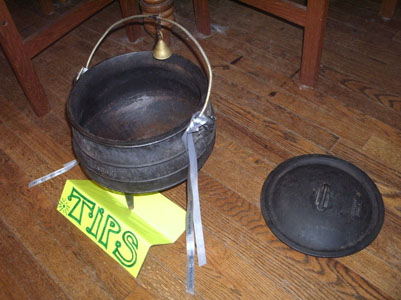
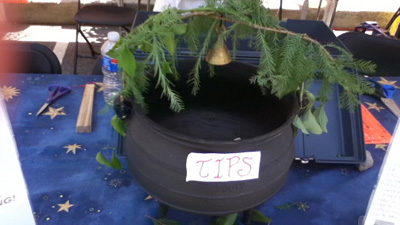
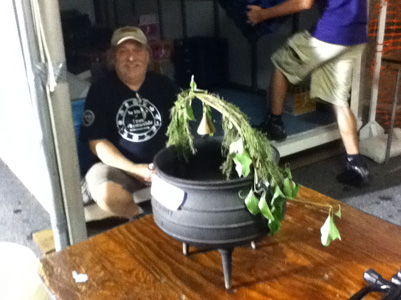
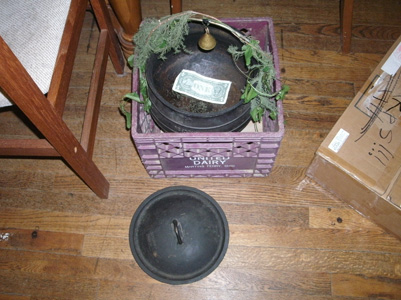
Coven Oldenwilde's magical Bele Chere belled cauldron gathered donations, gave blessings.

Magical belled cauldron gathers donations, gives blessings.

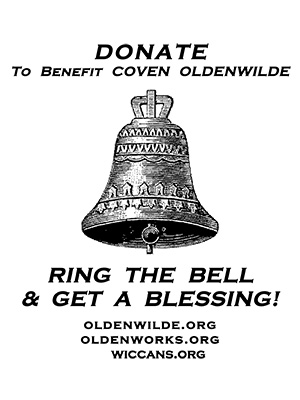
Sign: Donate to benefit Coven Oldenwilde. Ring the bell & get a blessing!

Sign: Donate to benefit Coven Oldenwilde. Ring the bell & get a blessing!

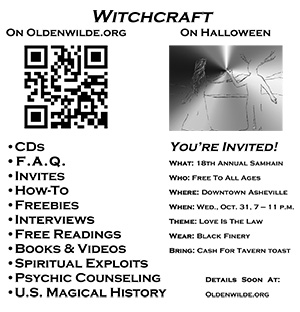
Witchcraft sign advertising Samhain 2012: Love is the Law

Witchcraft sign advertising Samhain 2012: Love is the Law

We experimented this year with using a greenery-decorated cauldron to collect tips, topped with a little bell people could ring for a blessing. It worked very well, and many people told us they enjoyed hearing the bell’s clear tone float over the crowd noise every time someone got a blessing.

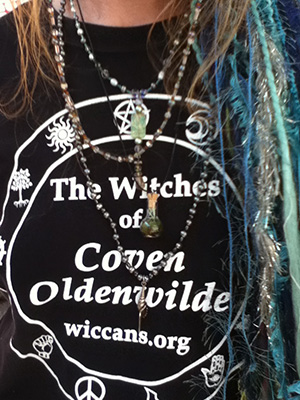
Lady Passion wearing her new terrarium talisman atop her Witches of Coven Oldenwilde T-shirt.

Lady Passion wearing her new terrarium talisman atop her Witches of Coven Oldenwilde T-shirt.

Closer view of terrarium talisman.

Closer view of terrarium talisman.

Local residents tend to avoid Bele Chere — they’re not big fans of Budweiser, for one thing, which still holds a controversial near-monopoly on the festival’s beer and ale sales in a city that’s become world-famous for its local breweries — but many went out of their way to find us and thank us for saving the magnolia trees and, in the doing, changing Asheville for the better (to sum up: more preservation, less corruption!). An artist, Tristan Hertz, who makes terrariums — living landscapes in glass containers — expressed his gratitude to Lady Passion by giving her the beautiful little pendant terrarium pictured here.

Other folks from all over came by to tell us how much they were learning from The Goodly Spellbook, show off their pentagrams (one man had 11 pentagram tattoos and counting!), pick up Lady Passion’s card in case they need magical or psychic help, or drop in a donation. One well-dressed man who came by to do so related to us that he was a elder in a conservative church whose pastor’s son was a big fan of the Harry Potter books. One Sunday the pastor was delivering a fiery sermon on the life to come. At its climax, he demanded of all assembled, “And when you get to heaven, who do you think you’ll see?” His son piped up loudly: “Witches!”, breaking the congregation up in laughter. As the man dropped in his donation, he looked toward the sky and smilingly prayed, “Jesus forgive me!”

Bob and cauldron after a busy Saturday evening for both.

Bob and cauldron after a busy Saturday evening for both.

Last donation being left in cauldron to charge it.

Last donation being left in cauldron to charge it.

When our last shift ended Saturday night and we’d folded up our starry tablecloth, rolled up our fringed banner, and packed away everything but the heavy iron cauldron, one more person stopped by to drop a donation in it. (We’re keeping it in there for luck.) Then, we heard Dixieland music coming from the middle of a huge, dancing crowd writhing up the street past us from the stage, as Yo Mama’s Big Fat Booty Band closed the show by marching off the stage and away through the Bele Chere crowd.

Posted in Community Service | Tagged , , , , | Comments Off

What Values do Pagan Spellbooks Teach?

Fundamentalist Christians here in Buncombe County, NC are upset because a local Pagan mother, Ginger Strivelli, is forcing the county public school district to stop distributing Gideon Bibles in elementary schools, after exposing the hypocrisy of school administrators in allowing Christian books while refusing the Pagan spellbooks she brought to test their self-proclaimed policy of equality. One outraged Christian parent wrote to the Asheville Citizen-Times to defend the values the Bible supposedly imparts, and sarcastically asked: “What values do Pagan spellbooks teach?”
Here is *Diuvei’s answer to her question. It will be published in the Asheville Citizen-Times on Wed., Feb. 8, 2012. (You can comment on it on the Cit-Times website.)

A recent letter defending the handing out of Bibles to schoolchildren asks, “What values do spellbooks teach?” Having co-written a Pagan spellbook that’s a popular textbook of magic, I’d answer that spellbooks’ magic teaches values absolutely critical for today’s schoolchildren to learn.

Magic imparts emotional maturity by teaching self-empowerment: To cast an effective spell, you can’t rely on money, popularity, beauty, muscles, drugs, guns — only your own intuition and will, guided by ethics and divination rather than commandment. Intellectually, magic teaches the “art of correspondences” — how to recognize the fundamental patterns that interconnect all things — which develops the skill of creative problem-solving by seeing whole systems rather than isolated parts. Physically, magic perceives the world as animated with spirit — an awareness that teaches students to treat nature and their fellow human souls with compassion, wisdom and love rather than materialism, violence and exploitation. Spiritually, magic embraces many goddesses and gods, teaching respect rather than intolerance for diversity of opinions, cultures, histories — and especially religions.

All in all, I’d argue that handing out Pagan spellbooks — on a Constitutionally equal basis with Bibles, of course — could even be America’s secret key to education reform.

Steve Rasmussen is the co-author with Lady Passion of The Goodly Spellbook: Olde Spells for Modern Problems, and can be reached via http://oldenwilde.org/.

Posted in Pagan Perspective | Comments Off

UNCA Interfaith Dialogue: “Is Religion Relevant?”

UPDATE: The event was lively and interesting, and the audience was SRO! Watch a video of it at http://www.youtube.com/watch?v=ewN2Pi8Xkgw&feature=share.

Symbols of many religions encircle the EarthPlease join us at a free Interfaith Dialogue panel at UNC-Asheville Thursday Nov. 17, 2011, from 7:00-8:30 PM at the Highsmith Student Union, downstairs in the Grotto. The Dialogue will have two main parts to it, the discussion from 7:00-8:00, and then the question and answer from the audience from 8:00-8:30 PM.

Here is the list of religions and representative  panelists as sent us by the student organizers:

  • Catholicism: Father John P. Cahill
  • Wicca: Lady Passion and *Diuvei
  • Zen Buddhism: Sunya Kjolhede
  • Conservative Judaism: Rabbi Robert Cabelli
  • Reform Judaism: Rabbi Batsheva Meiri
  • Humanist: Ms. Jackie Simms
  • Sikhism: Hari Mandar Singh Khalsa
  • Bahai: Dr. David Gillette
  • Sokka Gakkai Buddhism: Laura Petritz
  • Christian Pastor (Paradigm Church): Terry Hollifield
  • Muslim: Imam Kamal and Dr. Abdel Mayyas


UNCA students derived the topics and questions. They are:

Major Topic: Is religion relevant to the individual?
Sub-topics:

  • Does a religious view of the Afterlife shape the individual? If so, how so?
  • Does religion give us the answers to the meaning of life?
  • Does religion help individuals navigate the ups and downs of life?
  • How does religion affect the individual’s understanding of morality?

Major Topic: Is religion relevant to society? Is religion relevant to politics?
Sub-topics:

  • Pledge of Allegiance — “under God” — should we remove this, or keep it?
  • Do you believe that Asheville is a “cesspool of sin”?
  • Why are places of religious worship important to have in terms of community?
  • Does evil exist? How does your religion address evil?
  • What is your perspective on war?
  • How does religion address secular influences?
  • Is religion an opiate of the masses?

SHOULD BE A LIVELY DEBATE, and we hope to see you there! ;-)

Posted in Pagan Perspective | Comments Off

Karma will out

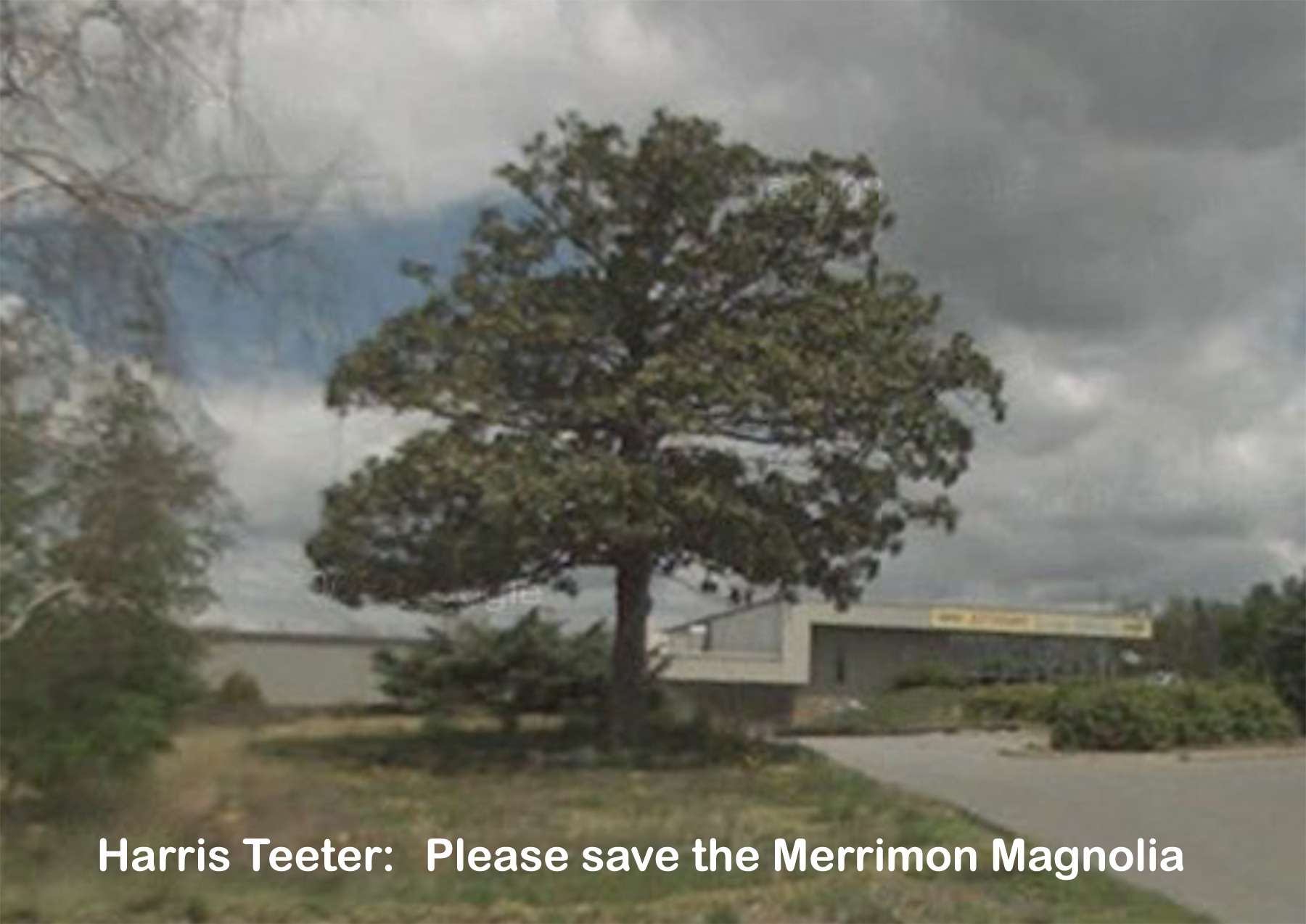
Here is Lady Passion’s statement emailed Sept. 25 to WLOS-TV on the destruction of the Merrimon Magnolia:

“Many people who loved this tree and fought for the past two years to save it are outraged that land-owner and former City Councilman and CIBO co-founder Chris Peterson makes money running Magnolia’s Restaurant, yet has the unmitigated gall to kill the beloved Merrimon Magnolia! Talk about showing contempt for the community’s desires!

As of last Thursday, despite promises made, Harris-Teeter had still not contacted Jack Thompson, director of Asheville’s Historic Preservation Society, to coordinate efforts to incorporate architectural relics from the site of the old Pack mansion in their proposed grocery store design.

Karma will out: I caution that everyone enabling this travesty may end up faring as badly as the Merrimon Magnolia.”

Posted in Merrimon Magnolia | 1 Comment

Farewell to a beautiful tree

We pushed as hard as we could to save the Merrimon Magnolia, but sadly we were unsuccessful, as we’ve just learned from a TV news reporter.

It was always a long shot, stymied at every turn by a lengthy history of other people’s environmentally stupid decisions: The car lot for whose sake the Pack mansion was razed some 40 or 50 years ago left the site a brownfield, and Harris Teeter says it’s legally required to grade the entire property, leaving no place on-site for the tree. All the surrounding streets are strung with low-hanging tangles of utility wires because Asheville has never required that they be buried, so the tree could not be transplanted to a nearby park. Our supposed “Tree City USA” has neither rules nor incentives for preserving landmark trees, and local developers in general are astonishingly ignorant about how they could, and why they should, care for them and make them focal points of their projects.

After I got the bad news today I made a mournful pilgrimage to a Hecate crossroads a mile or two from our Covenstead. As I walked home I noticed I was following the course of a stream running half-hidden through that neighborhood’s backyards. No matter how many parts of it developers had covered over with fill or pavement down through the decades, that stream still flowed, unstoppable. When I got to the main road, I realized the stream’s source was a small spring that bursts stubbornly through a crack in the asphalt driveway of a commercial parking lot.

We humans prate loudly at our podiums about our absolute rights to private property, but Nature just sits in the back row and smiles at our arbitrary claims to own and control and commodify Her. She’s the only real property owner, and She wins every argument in the end.

– *Diuvei

Posted in Merrimon Magnolia, Take Action | Comments Off

Press Release: Update on Merrimon Magnolia, Apr. 26, 2011

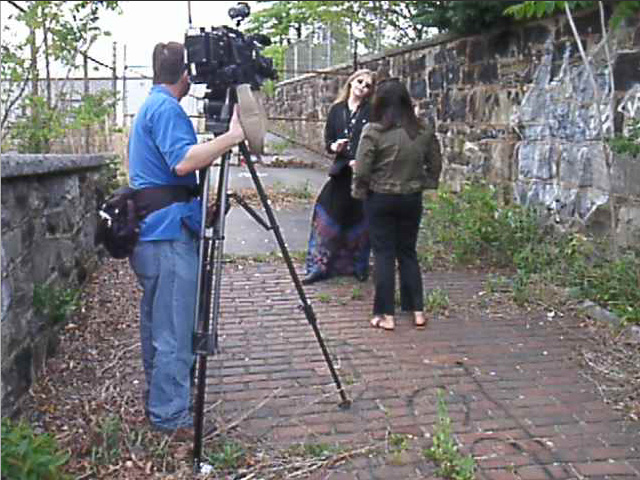
Lady Passion interviewed by Charu Kumarhia for WLOS-TV 13 NewsWatch our news interview on WLOS-TV 13 with Charu Kumarhia, 5pm or 6pm EDT Tues. April 26, or wlos.com

FOR IMMEDIATE RELEASE:
Saving the Merrimon Magnolia and George Pack’s stone wall

A large heritage magnolia on the former site of George W. Pack’s
mansion — now slated for a new Harris Teeter grocery store — could
be picked up and moved by a California company that claims the
Guinness World Record for the largest tree ever moved. The old tree is
in need of a new home, however.

An architecturally unique feature of the massive retaining wall that
once bounded Pack’s “Manyoaks” property will unfortunately be
demolished for the new store. Its stones will be incorporated into an
expanded bus stop at the site at 136 Merrimon Ave., which will include
a memorial to Pack. But anyone who wants to see the impressively
built, brick-paved carriage entrance to Manyoaks had better hurry,
because it will soon be added to the ever-lengthening roll of
Asheville’s lost historic treasures.

1) The magnolia tree

Asheville residents have been urging Harris Teeter to save the stately
magnolia at Merrimon and Chestnut through a Facebook page
(http://www.facebook.com/merrimon.magnolia), letters to the editor,
and a postcard campaign directed toward Harris Teeter’s president,
Fred Morgenthall, a resident of Charlotte
(http://oldenwilde.org/blog/93/take-action/send-a-postcard-to-save-the-merrimon-magnolia/).

At the final Technical Review Committee meeting last week that granted
the city’s approval to the development, Harris Teeter’s
representative, Garland Hughes, noted that grading requirements
related to the site’s brownfields status would not allow the magnolia
to remain in place. He assured concerned citizens, however, that the
company is interested in relocating the tree (as well as planting many
more trees on the site), had spoken about it with the city’s arborist,
Mark Foster, and would be open to proposals for doing so.

Moving big trees is not something many, if any, area arborists and
landscapers are equipped to do. So I followed a tip from local
landscape contractor Steve Ambrose
and contacted the Senna Tree
Company in La Crescenta, Calif. Senna’s website, www.sennatree.com,
shows the company transporting an 80-ton oak to a new site (I don’t
know if that is the tree that won them the world’s record!).

Surprisingly, the California company knows a lot about moving large
magnolia trees, I learned from president John Mote in an April 25
phone conversation, since they are a popular landscaping feature for
antebellum-style homes in the West. Based on the measurements and
photos I gave him (see
http://oldenwilde.org/gallery/main.php?g2_itemId=89), he informally
estimated his company could send a few men out here and relocate the
tree for about $25,000 to $30,000. [NOTE: $25,000 is just 1/100th of what Harris Teeter President Fred Morganthall makes in 1 year, and he is not even the company's highest-paid executive. So this should be quite affordable! -- S.R.]

Where to move the tree to, however, has not been decided. To survive,
the tree will need some 74 cubic feet of water twice a week without
interruption for months after transplanting, till it recovers from the
shock. One possibility I am suggesting to officials might be a nearby
public park or city greenway, where Parks and Recreation personnel and
citizen volunteers could ensure that it receives the regular attention
it needs during that period (and where it’s not likely to be uprooted
yet again by yet another building project).

2) The stone wall

In the late 1800s, several years before making his famous donation of
Pack Square to the city, George W. Pack built a grand mansion on
Merrimon Ave. that he named “Manyoaks.” The mansion was, sadly,
demolished in the 1960s or 1970s around the time the last Pack
descendant living in the house died, and the property became the Deal
Motor Company lot. [NOTE: After the last local Pack owner died, the mansion became a funeral home, and then was demolished when Deal Motor Company bought the lot, according to a longtime neighbor. -- S.R.]

But the massive stone retaining wall along Chestnut and Holland
Streets was left in place, along with two stone pillars and a section
of wrought-iron fence next to Merrimon. (Now only one pillar, thanks
to an auto accident last fall.)

As can be seen from the photo gallery at
http://www.oldenwilde.org/gallery/main.php?g2_itemId=29, a carriage
entrance graces the wall on Chestnut near Merrimon. The carefully
curved stonework of the entrance that terminates in two pillars is
unusual.

In response to public and official requests, Harris Teeter designed
its site plan so as to keep as much of the wall as its engineers
deemed possible. The stretch along Holland will remain intact
(although it will be penetrated by a pedestrian entrance), as will
much of the wall along Chestnut Street, which will not be widened
owing to neighborhood traffic concerns. However, the company will
install a large parking-lot entrance where the carriage entrance
stands now.

Harris Teeter is working with the city and the Asheville-Buncombe
Preservation Society to design an expanded bus stop at the present
stop on Merrimon by Chestnut, which will incorporate portions of the
demolished wall and possibly the iron fence and pillar on Merrimon. It
will likely include a historical plaque commemorating Pack’s former
residence here.

For more information:

Garland Hughes, Harris Teeter representative: (704)367-5003,
(704)622-5855, ghughes@mpvre.com

John Mote, Pres., Senna Tree Company: (818)957-5755, (818)279-3054,
www.sennatree.com

Jack Thomson, Director, Preservation Society of Asheville and Buncombe
County: (828)254-2343, director@psabc.org

Julia Fields, City Planning staff: JFields@ashevillenc.gov

Photos and information about the Manyoaks site:
http://www.oldenwilde.org/gallery/main.php?g2_itemId=29 and Montford
Newsletter article “Elegant Relics on a Car Lot: George Pack’s Lost
Merrimon Avenue Mansion”, http://montford.org/?p=953

– Steve Rasmussen
(828) 335-2486
(828) 251-0343

Posted in Merrimon Magnolia, Take Action | Comments Off

Letter to Asheville City Council re Ingles Smoky Park Hwy

Council should stand by city’s rules with Ingles

Tomorrow [March 22, 2011] City Council has a chance to prove why government matters. You can show the doubters on both right and left that the city of Asheville’s regulatory function is neither burdensome to the free market nor corrupted by special interests. Good government acts as a referee to ensure that the rules are applied fairly to all — no matter how wealthy, no matter how popular they may be.

Ingles has wisely agreed to abide by the city’s rules concerning parking-lot landscaping and pedestrian access at both Smoky Park Highway and Brevard Road. But the company still wants to install lights that are far brighter, and signs that are much larger and more numerous, than city ordinances allow — and, as city staff reports show, considerably brighter and bigger than the lights and signs of their law-abiding competitors.

No one can question the admirable legacy of generosity to Asheville that Bob Ingle Sr. left with his passing, both in contributing to charity and in creating local jobs. But it would tarnish that legacy for Council to treat it as though it implied a trade-off for special favors that aren’t granted to other, less influential businesses.

It would be both unfair and unsafe to grant Ingles a 400% increase in lighting over what the UDO allows for its fuel canopies. City staff’s lighting study shows other, competing gas stations are operating in compliance with our light-pollution ordinance (which is based on national standards). Those canopies are already extremely bright: Consider the dangerous night-blindness the lighting level requested by Ingles would induce in motorists.

It would also be unfair for Council to continue granting Ingles exceptions to our sign ordinance. Many small businesses already complain about imbalanced enforcement of the ordinance — remember how much flak the city caught for cracking down on Picnics’ chicken man? There’s a lot of resentment surrounding sidewalk-sign enforcement, too, as I’m sure you’re aware.

Consider how much more anger and disgust Council and staff will justifiably be subjected to if Council is seen to suspend the sign rules for Ingles while enforcing them on everyone else.

Stand fast by our city’s rules. Be the fair and consistent referee that Asheville’s businesses and residents want city government to be, to keep the playing field even for all. If Ingles feels that these rules are unfairly restrictive, then they should have come and sat at the table with the other stakeholders when these ordinances were drafted. They can still follow the proper process for requesting that the city consider amending the UDO — but for all players, not just for Ingles.

– Steve Rasmussen

FOR MORE INFO: Coalition of Asheville Neighborhoods Wiki at http://174.129.0.226/Issues/Conditional_Zoning/CZ_Ingles_Smoky_Park_Hwy

Posted in Take Action | Comments Off